High-speed dental handpieces are among the highest-speed and most precision instruments in a dental clinic, with their internal turbine bearings reaching rotational speeds of 300,000–500,000 rpm. Due to long-term operation under high speeds and exposure to high-temperature, high-pressure sterilization environments, insufficient lubrication or improper cleaning is the leading cause of bearing rust, seizure, and even complete scrapping of the handpiece.
This guide provides a detailed breakdown of the Standard Operating Procedure (SOP) for daily lubrication maintenance, helping clinics and hospitals extend equipment lifespan and reduce repair costs.
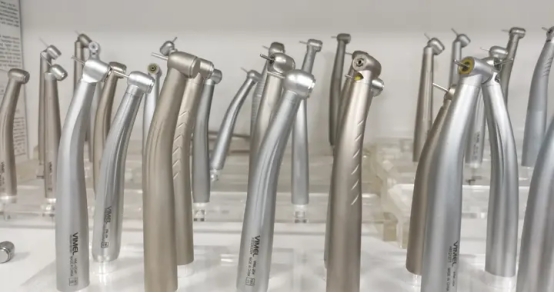
Step-by-Step Guide: From Cleaning to Lubrication
Proper maintenance is not simply "adding oil"—it is a closed-loop process of "cleaning – drying – lubricating – draining." Please strictly follow the steps below:
1️⃣ Step 1: Chairside Pre-Treatment (Critical!)
After use, do not immediately remove the handpiece.
· Action: Keep the bur installed on the handpiece, place the handpiece back on the dental unit tubing, and press the foot pedal to let the handpiece run dry with water spray for 30 seconds.
· Purpose: Use the water flow to flush away most tooth debris, blood, and saliva from the internal tubing and around the bearings, preventing contaminants from drying and solidifying.
2️⃣ Step 2: External Cleaning and Drying
· Action: Remove the handpiece and take off (or keep, depending on the cleaning method) the bur. Wipe the surface of the handpiece with a cotton ball or wipe dampened with 75% medical alcohol to remove visible stains and grease.
· Caution: Never soak the handpiece in disinfectant or water.
3️⃣ Step 3: Internal Cleaning (Debris Removal)
Before lubrication, residues inside the bearings must be removed.
· Tools: Aerosol cleaning lubricant (note: not pure lubricating oil) or a dedicated cleaning machine.
· Action: Align the cleaning nozzle with the handpiece's air inlet hole (typically the second-largest hole on a 4-hole handpiece, or the large hole on a 2-hole handpiece). Spray for 2–3 seconds. Use your finger to turn the bur to help loosen internal carbon deposits. Let the handpiece run dry to expel the dirty black oil until the discharged liquid becomes clear.
4️⃣ Step 4: Oil Lubrication (Core Step)
This is the key to preventing rust and seizure.
· Tools: Aerosol dental handpiece-specific lubricant, lubrication adapter (connector).
· Action:Position: Insert the lubrication nozzle vertically into the handpiece's air inlet hole. 4-hole handpiece: typically lubricate through the second-largest hole. 2-hole handpiece: lubricate through the large hole.Spray: Press the nozzle and spray continuously for 2–3 seconds. Ensure that clear new oil overflows from the handpiece head, indicating that old oil and impurities have been displaced.Wipe: Wrap the handpiece head with a paper towel and wipe away excess overflow oil.
5️⃣ Step 5: Oil Drainage and Final Drying
· Action: Reattach the lubricated handpiece to the dental unit tubing (without a bur or with a used bur installed), and run dry for 10–30 seconds.
· Purpose: Use centrifugal force to fling out excess lubricant from inside the bearings, leaving only an oil film adhering to the bearing surface.
· Warning: If this step is skipped, excess oil will carbonize during high-temperature sterilization, which can instead cause bearing sticking or seizure.
⚠️ Key Points and Pitfall Avoidance Guide
To ensure maintenance effectiveness, please pay close attention to the following details:
Table
Key Point | Explanation | Pitfall Tip |
No Ultrasonic Cleaning | High-frequency ultrasonic vibration can damage the balls and cage inside the bearing. | Never place the handpiece in an ultrasonic cleaner. |
Lubrication Timing | Must lubricate before sterilization . | During high-temperature sterilization, without lubricant protection, bearings will oxidize and rust due to the heat. |
Air Pressure Control | Inlet air pressure should be maintained at 0.20–0.25 MPa (approx. 200–250 kPa). | Excessive pressure accelerates bearing wear; insufficient pressure cannot effectively blow-dry the tubing. |
Bur Selection | Must use burs that meet international standards (1.59–1.60 mm). | Poor-quality or deformed burs can stretch the chuck (three-jaw spring), leading to reduced gripping force. |
❓ Frequently Asked Questions (FAQ)
Q1: Why does my handpiece still seize after sterilization, even though I lubricated it?
· Cause A: The handpiece was not cleaned thoroughly before lubrication, and residual tooth debris jammed the bearing during high-speed operation.
· Cause B: The "oil drainage" step was skipped after lubrication, and excess oil turned into sticky gum at high temperatures.
· Cause C: Poor-quality lubricant with inadequate heat resistance was used.
Q2: How many times a day should I lubricate?
· Recommendation: Perform a thorough cleaning and lubrication maintenance on all handpieces at the end of each day. For handpieces with extremely high usage frequency, simple lubrication maintenance after each patient treatment is recommended.
Professional Advice from Weimeile Medical
As Foshan Weimeile Medical Equipment Co., Ltd., we deeply understand that dental handpieces are the dentist's "second pair of hands." Beyond proper maintenance, choosing a handpiece with a precision structure and high-quality materials is the foundation of preventing failures. The high-speed handpiece series produced by Weimeile Medical adopts high-precision bearings and high-quality alloy materials, and with strict ISO 13485 production standards, greatly enhances durability. But please remember, "30% repair, 70% maintenance"—proper lubrication maintenance will make your Weimeile handpiece perform longer and cut more powerfully.
If you need more detailed video tutorials on handpiece maintenance or wish to purchase high-quality high- and low-speed dental handpieces, welcome to contact Foshan Weimeile Medical Equipment Co., Ltd. (Weimeile Medical)